About Dr. Montessori
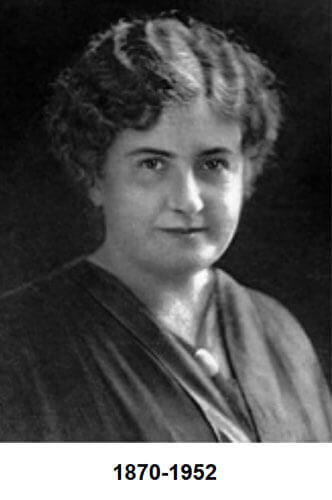
Dr. Maria Montessori was an Italian physician, educator, and
innovator, acclaimed for her educational method that builds on the
way children naturally learn.
She opened the first Montessori school - Casa dei Bambini or
Children's House - in Rome on January 6, 1907. Subsequently, she
traveled the world and wrote extensively about her approach to
education, attracting many devotees to her innovative pedagogical
approach. There are now thousands of Montessori schools in over 110
countries worldwide. Maria Montessori was born on August 31, 1870,
in the provincial town of Chiaravalle, Italy off the Adriatic coast.
Her mother was raised in a family that prized education, and as a
result, she was well-schooled and an avid reader, unusual for
Italian women of that time. As a passion for knowledge took root in
the young Maria, she immersed herself in many fields of scientific
study, eventually completing her Doctor of Medicine in Rome in 1896,
before creating the educational method that bears her name.
On Her Contribution to Education
Dr. Montessori created and propagated a new system for educating
young children based on materials and methods she originally
developed to teach students with special needs. The techniques
proved highly effective for all children. Her system, based on a
radical conception of liberty for the pupil and a structured
training of separate sensory, motor, and mental capacities, led to a
rapid and substantial mastery of reading, writing, and mathematics.
Apart from conducting teacher training workshops across British
India (including present-day Sri Lanka and Pakistan as well as
Ahmedabad, Chennai, Kodaikanal, and Pune amongst other cities in
India), the influential Italian educator, she also spoke and wrote
extensively on her philosophy and method. Her very first book, The
Montessori Method, published in Italian in 1909, outlines her
techniques of discipline, scientific pedagogy, diet, gymnastics,
manual labor, and the education of the senses, along with various
methods for teaching reading, writing, and arithmetic. The English
translation of this book reached second place on the U.S. nonfiction
bestseller list in 1912. Soon afterwards it was translated into 20
different languages. In 1948, she penned The Absorbent Mind, based
on her direct observations of Indian children in their learning
environment in the 1940s. It was through these experiences that she
came to the firm conclusion that it was the first six years of the
child that were the most crucial for their overall development.
Nominated for the Nobel Peace Prize three times, Dr.
Montessori also was an ardent proponent of world peace. Between
World War I and II, she published Education for Peace (1936) and
after the wars, Peaceful Children, Peaceful World (1949). During her
internment in India during WWII, she met such great figures as
Gandhi, Nehru, and Tagore, and the spirituality, generosity and
kindness of people in India left a strong impression on her. Dr.
Montessori said, 'It is not true that I invented what is called the
Montessori Method. I have studied the child, I have taken what the
child has given me and expressed it, and that is what is called the
Montessori Method." She urged all of us to 'follow the child'.