Best Montessori School in Gurgaon
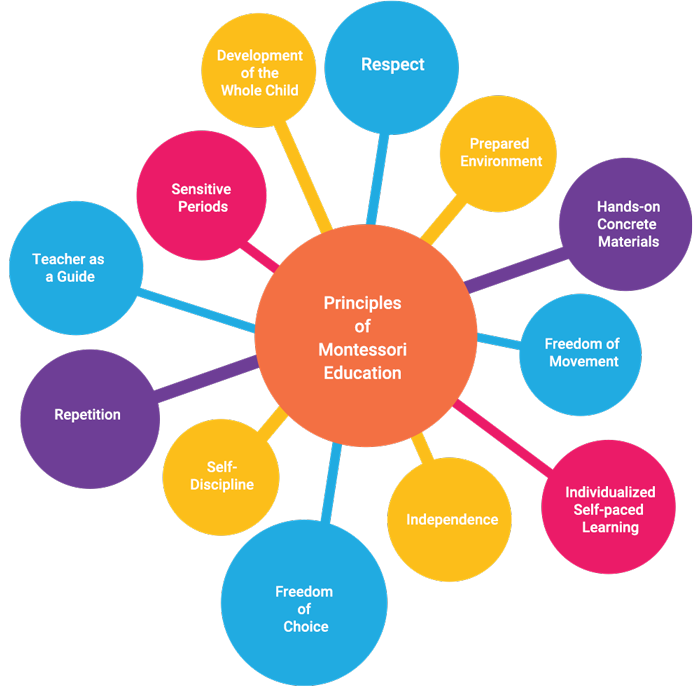
Principles of Montessori Education
Respect
Respect for a child involves understanding the developmental stages and needs of the child at each stage, freedom to choose and move, and work at their own pace, which leads to independence, orderliness, concentration and self-confidence. Demonstrating respect for your child early on helps them grow to be courteous, kind, thoughtful, and compassionate human beings.
Prepared Environment
Our Montessori classrooms are meaningfully structured and prepared for a child's learning where everything has a purpose and a place. The prepared environment also includes child-sized furniture, hands-on materials, and freedom of movement where children can learn social and academic skills while developing into independent human beings. The materials are arranged from simple to complex and from concrete to abstract, catering to every child's age and ability.
Hands-on/concrete materials
Hands-on activities allow children to use all their senses to discover the world around them, keeping them captivated and focused on the objects at hand. All Montessori manipulative materials are designed to teach an abstract concept in a concrete way. It does not emphasize rote learning but internalization of how and why. This visual, sensory, auditory and tactile,hands-on approach to learning enables the children to explore the materials in a way that is appropriate for their developmental stages.
Freedom of Movement
Within the Montessori classroom, children have freedom to learn by observing others' work and moving from one activity to the next. Children learn from observing their peers, which forms their own inner guidance in the process. There are cycles of activities and the children are encouraged to finish one activity or exercise and then move on to the next, gently guided by the teacher/facilitator. Freedom is within limits, wherein they respect the other children in their classroom and their work.
Individualized/self-paced learning
Children are allowed to work with the same material for as long as they like. This encourages them to learn at their own pace, developing concentration and enhancing their attention span. Each child can work with individual pieces of material for a longer period of time in order to internalize the concept before moving on.
Independence
Dr. Montessori observed that the children like to act independently and one of her famous quotes is, 'help me to help myself'. In the Montessori classroom,independence is an ongoing and organic process; as the child learns to do spooning and pouring exercises, tie their own shoes, or clean their own workspace, they become more confident individuals who become independent adults. They develop a sense of personal responsibility and the ability to learn independently is essential for success in life.
Freedom of Choice
The prepared environment in a Montessori classroom allows the child to discover their needs, interests, and abilities; it encourages children to be engaged in their own learning. Children are free to choose exercises once they have had lessons and prior presentations from their teacher.
Self-discipline
In the Montessori class, we seek to develop the child's self-discipline by establishing classroom rules, thereby exercising freedom in a responsible way. We use clear communication and positive guidance to teach children about self regulation,acceptable and unacceptable behavior.
Repetition
Children are given the opportunity to work with materials/exercises and through practice/repetition they learn to self-correct and self pace their learning. Repetition enables them to internalize hard-to-understand abstract concepts.
Teacher as a Guide
The role of the teacher in a Montessori classroom is not to lecture, but rather to guide. They are trained to be aware of each child's progress and skill level as the children work towards mastering important concepts.The teachers are trained to constantly watch and observe each child's progress, as well as when to step in to offer guidance or when to allow the child to work independently.
Sensitive Periods
These are periods of time when a child has an intense desire and fascination for learning a new skill. Their internal guidance allows them to focus on the development of a certain skill. The most important sensitive periods occur between birth and age six (examples are -movement, spoken language, sense of order,sensorial exploration,social interaction and fascination with small objects, etc).
Development of the Whole Child
The Montessori philosophy embraces the whole child and nurtures her/his natural curiosity and love of learning. Children will reach their full potential emotionally, socially and intellectually when given the freedom of choice to actively work with concrete, sequentially arranged materials within a prepared environment. Learning takes place through movement and incorporates all the senses, creating pathways and synapses in the brain that cannot be undone.